
Why just‑in‑time supply chains make our economies live on the edge
(Published by JP Bouchaud | Feb 2026)
In our recent PNAS Perspective “Critical Fragility in Socio‑Technical Systems” we argued that many systems built on timeliness – trains, flights, hospitals, supply chains – are pushed by efficiency pressures right up to their limiting operational performance. As "temporal buffers" and redundancies are shaved off, the system becomes critically fragile: small delays or local problems can propagate and trigger avalanches of disruption.
In a new paper with David Martin, José Morán, Debabrata Panja, we show that something very similar happens in production networks with perishable, non‑substitutable inputs.
The key message is summarized in the Figure below: for a given level of exogenous productivity shocks (sigma), precautionary inventories must be large enough (kappa large) for the economy to be resilient. Aggregate production then fluctuates around a steady state with small volatility.
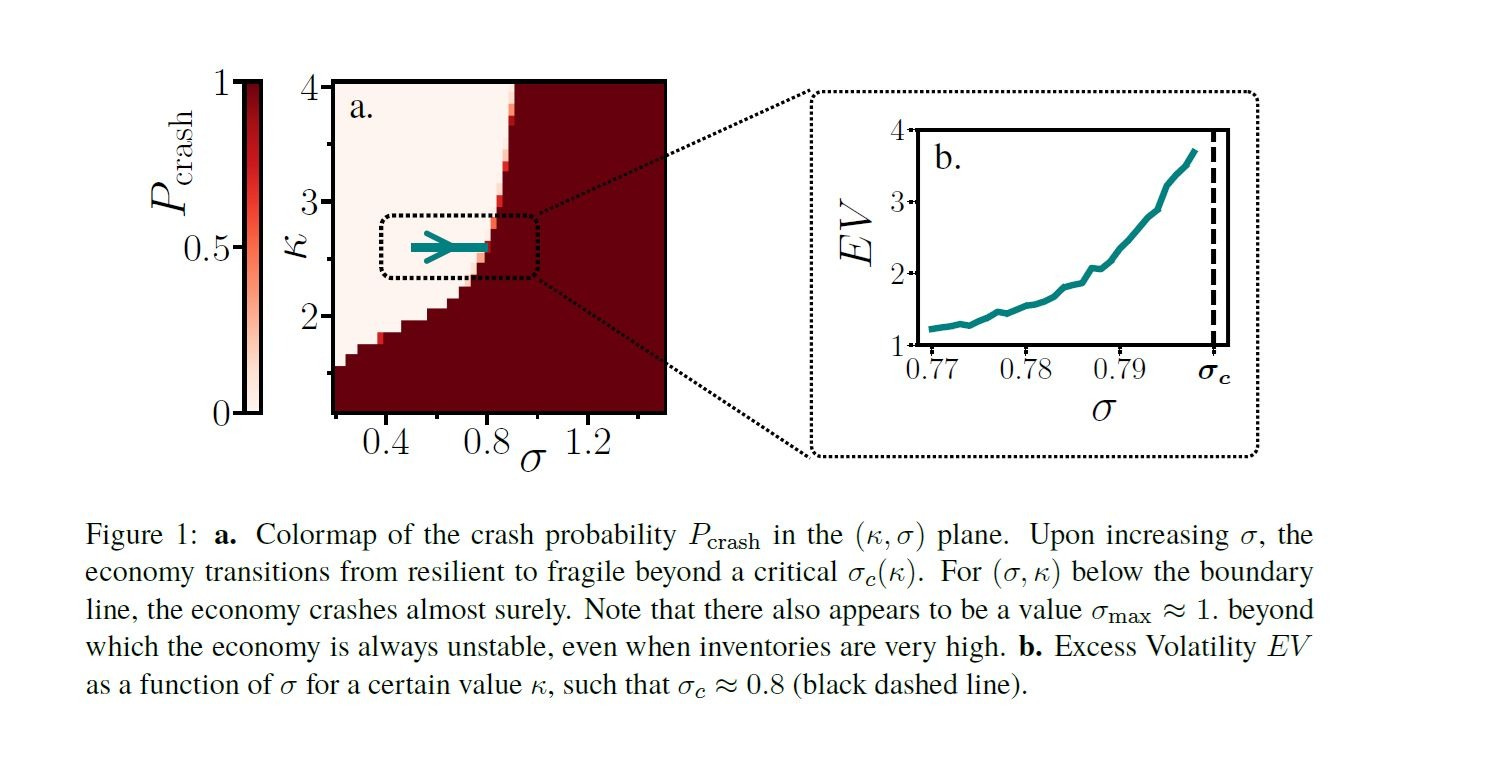
Below a a sharp critical line, the economy is fragile: in large systems, cascading shortages almost surely lead to a system‑wide collapse in finite time.
As the system approaches this critical line from the resilient side, the ratio of aggregate output volatility to underlying productivity volatility rises sharply. Even when shocks are purely idiosyncratic and small at the firm level, network propagation and thin inventories generate large, endogenous macro fluctuations.
Now, keeping inventories is costly, so firms have strong incentives to minimize them (the ''just‑in‑time'' paradigm). These micro‑incentives, reinforced by competition, gradually push the system toward the critical boundary where efficiency is high but resilience is low.
When we optimize socio‑technical systems too aggressively for efficiency and timeliness – whether in train schedules or global supply chains – we do not just save costs; we also move closer to a critical state where volatility, crises and “small shocks, large cycles” become a structural feature rather than an exception. Elucidating the very mechanisms leading to instabilities, failures, and system-wide crises in such systems is crucial to finding the sweet spot between efficiency and resilience.
This is most interesting and related to some passive fragility work with Stephan Sturm and Mike Green that will hopefully be released soon. I have sent you an email with details. Cheers, Hari