
Physics Nobel Prize
(Published by JP Bouchaud | October 2022)
For the second year in a row, the Nobel prize in physics has been awarded to one of my scientific heroes. Last year it was Giorgio Parisi, who revolutionized the science of complex systems. This year it is Alain Aspect, who open the way to the second quantum revolution with a truly heroic experiment in the early 80’s, where he showed that the world described by quantum mechanics is fundamentally non local. To wit, there appears to be some information propagation faster than the speed of light between particles prepared in the same “entangled” quantum state – something forbidden by Einstein’s special relativity. Aspect actually turned Einstein’s “Gedanken” experiment (i.e. a thought experiment, imagined merely to make a point) into a real thing – and showed that quantum mechanics, in a sense, trumps special relativity.
Well, in fact there is no faster-than-light propagation at all: until quantum coherence is destroyed by interactions with the environment (or the measurement apparatus), space separation is simply irrelevant, but classical intuition has a hard time making sense of what quantum coherence means. What is the “glue” allowing far away particles to be part of the same quantum object? Is there an intrinsic space or time limit to quantum coherence? There are clearly things we still do not fully understand about the quantum world, with possibly profound theoretical consequences.
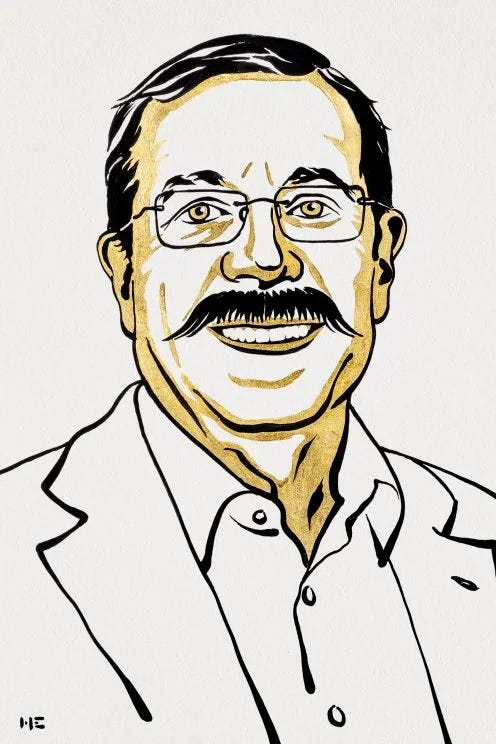
I am particularly happy for Alain, a truly fantastic physicist, who inspired generations of students, including myself. I was fortunate enough to collaborate with him in the 90’s, when we worked together on "how rare events can bring atoms to rest" (aka laser cooling). This led us to write a book, together with Francois Bardou and Claude Cohen-Tannoudji. My contribution was chiefly to bring to their attention the importance of “heavy tailed” distributions – something I had been busy working on for several years, in particular in the context of financial time series. Cross-disciplinarity often leads to wonderful surprises.